 Armhanq.com ՀԱՅԱՍՏԱՆԻ ՀԱՆՔԱՐԴՅՈՒՆԱԲԵՐՈՒԹՅԱՆ ԵՎ ՄԵՏԱԼՈՒՐԳԻԱՅԻ ԱՍՈՑԻԱՑԻԱ
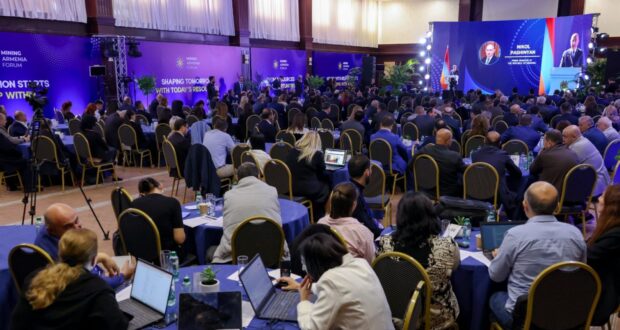
A two-day conference titled “Mining and Energy: International Trends and Armenia’s Potential” was held in Tsaghkadzor, bringing together more than 250 representatives from government agencies, the private sector, and investment companies from eight countries. The event was also attended by the Prime Minister of Armenia.
Prime Minister Nikol Pashinyan noted that the sector offers both significant opportunities and serious challenges. According to him, the platform provides an opportunity—including for the government—to discuss all relevant issues with industry representatives in this format.
Education is also a key issue in the mining sector. The development of a knowledge-based economy requires particular attention to workforce training and capacity building.
Mining is a key driver of Armenia’s economy. According to analysts, this often controversial sector provides the largest number of jobs in the country. Speaking to Radiolur, Aghasi Tavadayan, an expert at the “Amberd” Research Center, emphasized the importance of mining to Armenia’s economy. He noted that in recent years economic activity has become increasingly concentrated in Yerevan. Citing statistical data, he stated that 79% of the country’s wage fund is concentrated in the capital.
“It can be argued that this is the primary—and almost the only—sector. It ensures significant economic growth in the regions and helps avoid excessive concentration in Yerevan, which in recent years has become the main driver of economic growth. We also see that mining is contributing to economic development in the regions.” At present, it is clear that the sector is not ready to relinquish its position. Armenia accounts for approximately 3–4 percent of global molybdenum exports. The event titled “Mining and Energy: International Trends and Armenia’s Potential” brought together more than 250 representatives from government bodies, the private sector, and investment companies from various countries.
Vardan Jhanyan, President of the Armenian Mining and Metallurgy Association, noted that in the coming years gold, copper, and molybdenum will be in high demand on the global market, which will have an impact on Armenia’s exports. “In a few years, we may achieve a positive foreign trade balance, which would contribute to a strong economy and an improved quality of life for the population.” Armenia’s Prime Minister noted that the sector offers both significant opportunities and serious challenges. According to him, the platform provides an opportunity—including for the government—to discuss all issues with industry representatives in a working format.
Nikol Pashinyan also stated that when mining is mentioned in Armenia, it is mainly associated with the exploitation of metallic mines. This perception, he explained, is well-founded, as metallic mining accounts for 95 percent or more of the sector. “It is clear that subsoil resources belong to the state and the people. The challenge is that in Armenia’s public consciousness this understanding—that subsoil resources belong to the people and the state—has not always been fully accepted, and the time has come for us to address this issue, which we are actively doing. I would like to draw attention to the fact that the Government of Armenia—and, through the government, the people—now effectively holds a stake in the Zangezur Copper-Molybdenum Combine as well as a stake in the Amulsar mine, which is highly significant.” “I would also like to emphasize that we have made a significant amendment to the Law on the Budgetary System with regard to affected communities, specifically the allocation of 2 percent of mining royalties.”
Prime Minister Nikol Pashinyan highlighted statistical data, noting that between 2018 and 2025, the Zangezur Copper-Molybdenum Combine (ZCMC) increased its payments to the state budget by 148 percent compared to the previous seven-year period- more than doubling the amount.
The Prime Minister also expressed surprise that Armenia is experiencing a shortage of stone, despite the fact that, as he noted, nearly every third sentence describing Armenia refers to it as a “land of stone.” He emphasized that there is significant work to be done in the stone extraction and processing sector, stating: “To implement subsidized programs in our communities, we import stone from abroad. This indicates that we have a problem. There is work to be done in the stone-processing sector. First, it represents potential for our economy, and second, it provides an opportunity to showcase our country’s unique character within Armenia.”
The Mining Development Strategy, approved in 2023, is aimed at supporting the regulation and advancement of the sector. It prioritizes long-term economic development and the efficient management of natural resources, according to David Khudatyan, Minister of Territorial Administration and Infrastructure. The Prime Minister emphasized the importance of transparency in the sector. Nikol Pashinyan also noted that Armenia will host the COP17 Conference of the Convention on Biological Diversity next year.